
Treatment
Root canal treatment in Singapore
A root canal treats the infection causing your toothache, and it is how we try to keep a tooth that would otherwise have to come out. It is the treatment that takes the pain away, not the cause of it — that is the part the phrase has never managed to convey.
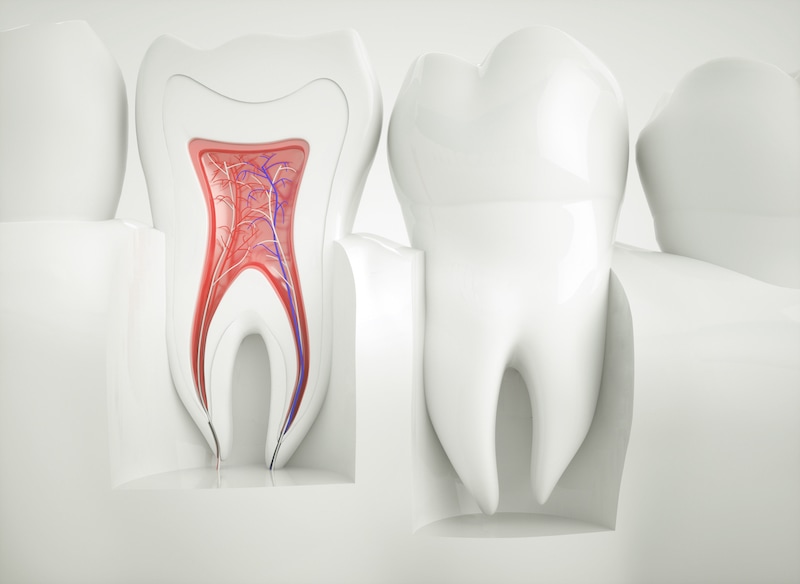
The most obvious sign that you might need root canal treatment is that a tooth hurts — an excruciating pain or a deep throbbing one. The gum nearby may be swollen and sore for an extended period. These are signs that the pulp inside the tooth, the soft tissue carrying its nerve and blood supply, has become infected or inflamed.
Root canal treatment removes that infected tissue, cleans out the space it occupied, and seals it. The tooth stays where it is.
Signs you may need a root canal
- Severe or throbbing toothache, often worse at night or when lying down.
- A swollen, tender gum near the tooth.
- Sensitivity to hot or cold that lingers after the drink or the food is gone. Brief sensitivity that stops immediately is a different thing and usually less serious.
- Pain on biting or when the tooth is tapped.
- A tooth that has darkened compared with its neighbours.
- A small pimple on the gum that comes and goes, sometimes with a bad taste. That is a sinus tract draining an abscess.
One warning that matters more than it sounds. A tooth that hurt badly and then stopped hurting has often not got better. The pulp has died, so it can no longer signal pain — but the infection is still there, and it is still working its way into the bone. If your toothache disappeared on its own, please still get it looked at.
What causes the infection
Deep decay is the usual route, reaching the pulp through the tooth. A crack or a fracture can do the same, and so can trauma — a knock to a front tooth can kill the pulp years before anything hurts. Repeated dental work on the same tooth adds up too, each intervention taking the pulp a little closer to the edge.
This is why "but I brush well" and "I had that tooth filled last year" are not contradictions. Sometimes it is nobody's fault at all.
What happens during root canal treatment
- An X-ray to see the number and shape of the roots and how far the infection has spread.
- Local anaesthetic, so the tooth is properly numb before anything begins.
- A rubber dam is placed over the tooth. It isolates it from the rest of your mouth, keeps it clean and dry while we work, and stops anything going anywhere it should not.
- An opening is made through the top of the tooth, and the infected pulp and any decayed tooth structure are removed. The tooth itself stays in place — nothing is taken out of your jaw.
- Cleaning and shaping. Very fine files are used to clean out and shape each root canal along its length.
- Disinfecting, to deal with what the files cannot reach.
- Filling and sealing the canals with gutta-percha, a rubber-like material that fills the space so bacteria cannot recolonise it.
- Restoring the tooth — a filling, and for back teeth usually a crown.
Most treatments take one or two appointments of around an hour to ninety minutes. Between appointments the tooth is sealed with a temporary filling.
Does a root canal hurt?
It is the question, so here is the straight answer.
The infection is what hurts. By the time most people arrive, they have had a few very bad nights. The treatment is what takes that away, and the relief usually starts the same day.
During the appointment the tooth is numb. You will feel pressure and vibration and you will hear the instruments, and none of that is pain. If anything sharp does get through — which happens occasionally with a badly infected tooth, because inflamed tissue is harder to numb — tell us straight away. We will stop and add more anaesthetic. You do not have to be stoic about it.
Afterwards, the tooth is commonly tender to bite on for a few days, sometimes up to a week, while the inflammation in the ligament around the root settles. That is normal and it fades.
Afterwards
Chew on the other side until the tooth is permanently restored — a temporary filling is not built for full chewing loads. Take the painkillers we prescribe or recommend, exactly as directed, and tell us about any medicines you take. Keep brushing and flossing the tooth normally.
Why the restoration matters. You may have heard that a root-treated tooth becomes brittle. That explanation is out of date. What actually happens is simpler: between the decay that caused the problem and the opening made to treat it, the tooth has lost a good deal of its own structure. Less structure means more chance of it splitting under a heavy bite. For back teeth, a crown covers the biting surface and holds everything together, which is why we usually recommend one. Front teeth take much gentler loads and often manage with a filling.
When it does not work. Most root canal treatments succeed, but not all of them do. Root canals can be narrow, curved or branched in ways that make every corner hard to reach, and infection sometimes persists or returns months or years later. If that happens the options are retreatment, a small surgical procedure at the tip of the root, or removing the tooth. We would tell you at the outset if we thought your tooth was one of the harder ones.
When to ring us
Some tenderness for a few days is expected. Call us if the tooth is getting more painful after the third day rather than less, if your face or gum starts to swell, or if you feel feverish or generally unwell.
And if a doctor has already given you a course of tablets for this tooth, please still come in once the pain has gone. Tablets can quieten an infection for a while, but they cannot reach what is inside the tooth. The pain coming back is what usually happens next.
Root canal or extraction?
People ask this, and they deserve a straight answer rather than a sales pitch in either direction.
Saving a natural tooth is usually the first thing to look at. Your own tooth is already the right shape, in the right place, attached to your jaw by a ligament that gives it feedback nothing artificial reproduces.
But not every tooth can or should be saved. A tooth with a cracked root, or one broken off below the gum line, may be better out. And if a tooth has already been root-treated twice, at some point continuing stops making sense.
What we will not do is tell you that extraction is more expensive. Taking the tooth out is one appointment; the gap it leaves is a separate question with its own timeline and cost, whether you choose to fill it with an implant, a bridge or nothing at all. Comparing the two properly means comparing the whole path, not just the first step, and that is a conversation to have with the X-ray in front of you.
What it costs
Root canal prices depend on which tooth it is and how many canals it has — a front tooth with a single straight canal is a different job from a lower molar with four. Whether a crown follows changes the total again.
We would rather quote you accurately than publish a range wide enough to be useless. Bring the tooth in, and you will get a written quote covering the treatment and the restoration together, so there is no second bill you did not see coming. Our cost guide covers the treatments where we have settled pricing.
Why have it done here
If you are frightened of this, say so — it is the treatment people are most frightened of, and it is almost always less bad than expected. We have computer-controlled anaesthesia for people whose real problem is the injection. We take our own X-rays here, so there is no being sent elsewhere first. And if it turns out the tooth cannot be saved, we can talk about what comes next in the same conversation rather than starting again somewhere else.
If you are in real pain right now, call us rather than messaging. Please also read the box below — there are a few symptoms that need help faster than a dental appointment.
Questions
What people ask
before booking
Does a root canal hurt?
The infection hurts. The treatment is what stops it. Your tooth is thoroughly numbed throughout, so during the appointment you should feel pressure rather than pain — and if anything sharp gets through, tell us and we will top up the anaesthetic. Afterwards the tooth is usually tender to bite on for a few days while the inflammation settles.
How many visits will I need?
Commonly two, sometimes one, occasionally more if the tooth has several canals or the infection is stubborn. A back tooth with three or four canals takes longer than a front tooth with one. We will tell you what to expect after the X-ray rather than making you find out as you go.
Do I definitely need a crown afterwards?
For back teeth, usually yes — they take heavy chewing loads and a root-treated molar has lost a lot of structure. For front teeth, often not; a well-sealed filling is frequently enough. It depends on how much of the tooth was left once the decay was removed, and we will show you on the X-ray rather than simply telling you.
What happens if I leave it untreated?
The infection does not resolve on its own. It can spread into the bone around the root and form an abscess, and the tooth becomes progressively less saveable. If the pain stops without treatment, that is not recovery — it usually means the pulp has died, and the infection is still there. Left long enough, the choice narrows to extraction.
How long does a root-treated tooth last?
Many last for years and go on doing normal work, particularly when they are properly restored afterwards and kept clean. The two things that shorten it are fracture, which is why the restoration matters, and new decay elsewhere on the tooth. A root-treated tooth still needs brushing, flossing and check-ups like any other.
Is root canal treatment claimable under MediSave?
We would rather check than guess. MediSave covers specific listed procedures, and whether a particular root canal treatment qualifies is not something we want to answer with a general rule — surgical endodontic procedures sit differently from routine ones. Ask us and we will confirm your case in writing before you commit to treatment.
Related treatment
Reviewed by Dr Wong Chi Him Benedict, 14 October 2026.
This page is general information about a treatment we offer. It is not advice about your own case, and it is not consent — we go through the treatment, the alternatives and the risks with you at the clinic before anything begins.
No commitment
Ask what your
treatment would
involve
A consultation will tell you what your options are, what treatment would involve and what it would cost, in writing. You are free to leave it there.