
Treatment
Dental X-rays and 3D CBCT scanning
An examination shows us the surfaces of your teeth. Imaging shows us everything else — between the teeth, inside them, and in the bone underneath.
Why dentists take images
Quite a lot of what matters in a mouth cannot be seen by looking at it.
- Decay between teeth, where the surfaces touch and no examination reaches.
- Decay under an existing filling or crown.
- The level of bone around the teeth, which is how gum disease is measured rather than guessed at.
- Infection at the root tip, which shows in the bone before it shows anywhere else.
- Impacted teeth — wisdom teeth in particular — and which way they are pointing.
- The position of nerves and sinuses, before any surgery near them.
- The shape and number of root canals, before root canal treatment.
We take images when they will change what we do. If the answer would be the same either way, there is no reason to take one.
The types, and what each is for
Bitewing — a small image of the crowns of the back teeth, upper and lower together. This is the one that finds decay between teeth early, while it is still a small filling.
Periapical — a single tooth from crown to root tip, plus the bone around it. Used before root canal treatment, when a tooth is painful, and to check a root after treatment.
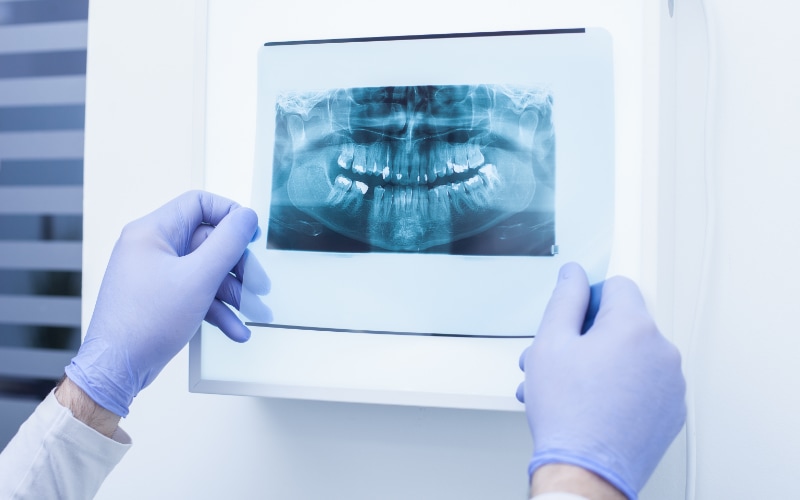
Panoramic (OPG) — the whole upper and lower jaw in one wide image. Useful for wisdom teeth, for seeing how a child's adult teeth are developing, and for an overview when someone has not been seen in a long time.
CBCT — a three-dimensional scan. This is a different class of information rather than a better version of the same thing.
What 3D CBCT adds
A conventional X-ray is a shadow: everything between the source and the sensor lands on one flat image, overlapping. You can see that a root is near a nerve, but not whether it is in front of it, behind it, or through it.
A CBCT scan reconstructs the region in three dimensions, and that changes several things we do:
- Placing implants. We can measure how much bone there is in every direction, see exactly where the nerve in the lower jaw runs, and see where the sinus floor sits above the upper back teeth. This is what makes the difference between planning an implant and estimating one, and it is why we scan before quoting — it also tells us whether a bone graft will be needed, which is usually the biggest surprise in an implant plan.
- Wisdom tooth surgery. Where a lower wisdom tooth's roots sit close to the nerve, a 3D scan shows the actual relationship rather than an ambiguous overlap. That is precisely the case where knowing in advance matters most.
- Difficult roots and persistent infections, where a flat image has not explained the problem.
Is dental imaging safe?
The doses involved in dental radiography are low, and modern digital sensors require less exposure than the film they replaced.
We would rather give you the fuller answer, though, because it is the more useful one. A CBCT scan involves more radiation than a standard dental X-ray. That is exactly why it is not used routinely — it is used where a three-dimensional picture will change the treatment, which in practice means implants, some wisdom teeth and some complex root problems. The safeguard is not that the dose is negligible; it is that we take images when they earn their place.
If you are pregnant or think you might be, tell us. Routine imaging can wait; an active infection may not, and we will talk that through with you.
What to expect
Both are quick. For a bitewing or periapical, a small sensor is placed in your mouth and you bite gently on a holder — it takes a second or two, and the honest caveat is that some people find the holder uncomfortable or gag on it. Tell us and we will adjust the position.
For a CBCT, nothing goes in your mouth at all. You sit or stand still while the machine rotates around your head, for a few seconds.
Because everything is digital, the images are up on the screen straight away, and we will go through them with you rather than reading them privately and reporting a conclusion. If you want to see what we are looking at, ask — most people find the picture makes the recommendation much easier to follow.
What it costs
Imaging is usually part of the appointment or the treatment it is taken for, rather than a separate item sprung on you afterwards. A CBCT scan is the exception: it is quoted with whatever is being planned, most often an implant or wisdom tooth surgery.
Questions
What people ask
before booking
How often do I need dental X-rays?
There is no fixed schedule for dental X-rays. How often depends on your risk of decay, the state of your gums, your age and what we can see. Someone with a history of decay may need images more often; someone with sound teeth and healthy gums, much less. We decide it case by case.
Are dental X-rays safe?
Doses in dental radiography are low, and digital sensors need less exposure than the film they replaced. The more useful answer is that we only take an image when the information will change what we do — an X-ray taken out of routine gives you the exposure without the benefit. That judgement is the real safeguard.
What is the difference between an X-ray and a CBCT scan?
An X-ray is a flat image — structures at different depths overlap in it. A CBCT builds a three-dimensional picture, so we can measure heights and widths and see exactly where a nerve or a root sits. A CBCT involves more radiation than a standard dental X-ray, which is why we use it selectively rather than routinely.
Can I have a scan if I am pregnant?
Tell us if you are pregnant or think you might be, and we will avoid imaging that is not necessary and postpone what can wait. Where there is an active infection or real pain, treating it may well be the safer course, and we will discuss that with you rather than deciding for you.
Related treatment
Reviewed by Dr Wong Chi Him Benedict, 14 October 2026.
This page is general information about a treatment we offer. It is not advice about your own case, and it is not consent — we go through the treatment, the alternatives and the risks with you at the clinic before anything begins.
No commitment
Ask what your
treatment would
involve
A consultation will tell you what your options are, what treatment would involve and what it would cost, in writing. You are free to leave it there.