
Treatment
Braces and Invisalign in Singapore
Both straighten teeth. They suit different lives, different cases and different budgets. This page is written to help you work out which one is actually right for you, rather than to sell you the more expensive one.
Orthodontic treatment moves teeth into better positions, gradually, using gentle continuous pressure. Fixed braces do it with brackets bonded to the teeth and a wire connecting them. Clear aligners do it with a series of removable plastic trays. The biology is the same in both cases; what differs is how it feels to live with, what it can achieve, and what it costs.
What braces and aligners can fix
- Crowding — teeth overlapping because there is not enough room.
- Gaps between teeth.
- Overbite, where the upper front teeth sit too far over the lower ones.
- Underbite, where the lower teeth sit in front of the upper.
- Crossbite, where the upper and lower teeth meet the wrong way round on one side.
- Rotated or tipped teeth.
Straighter teeth are easier to clean, which matters more than appearance in the long run. Crowded overlapping teeth trap plaque in places a brush cannot reach, and that shows up as decay and gum disease years later.
Be aware that severe cases — significant skeletal discrepancies between the jaws, or teeth that need substantial movement through bone — may be beyond what clear aligners can do, and occasionally beyond what any braces can do without surgical input. Where that is the case we will say so and refer you to a specialist rather than attempting something that will disappoint you.
Traditional fixed braces
Small brackets are bonded to the front of each tooth and connected by a wire. The wire is what does the work: it wants to return to its own shape, and in doing so it applies steady pressure that moves the teeth along with it.
The fitting appointment takes an hour or two. The teeth are cleaned and dried, the brackets are bonded on, and the first wire is placed. It is not painful — nothing is being cut or drilled — though holding your mouth open that long is tiring.
Afterwards, expect soreness for a few days as the teeth start to move. Soft food helps. The same happens, more mildly, after each adjustment.
Adjustments happen every few weeks, and take much less time than the fitting. This is where the wire is changed or tightened as the teeth progress.
What you cannot eat. Hard and sticky things — ice, hard nuts, sticky sweets, anything you would have to bite hard into. Cut apples and carrots rather than biting them. Brackets do come off occasionally; it is a nuisance rather than a disaster, but it adds appointments and can add time.
Invisalign and clear aligners
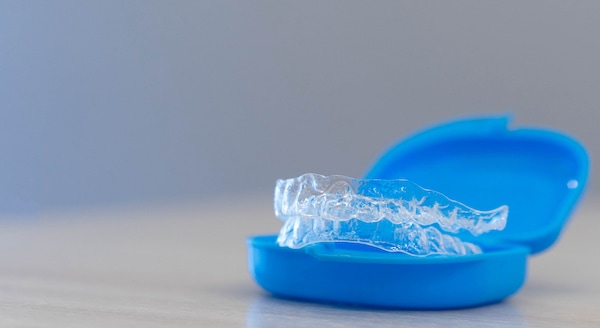
Invisalign looks rather like a thin retainer, made of clear lightweight plastic. It is a series of aligners — trays that sit over the teeth, each one shaped slightly differently from the last, so that changing to the next one applies pressure in a new direction. Trays are usually changed every one to two weeks.
They are much less noticeable than fixed braces, which is why most adult patients prefer them. They are not invisible, though: most cases need small tooth-coloured attachments bonded to some teeth to give the aligners something to grip, and those show close up.
The advantage that matters day to day is that they come out. You remove them to eat, and to brush and floss normally, which means no food restrictions and much easier cleaning.
The catch is the same thing. Aligners work only while they are in your mouth, and that means around 20 to 22 hours a day — out for meals and cleaning, in for everything else, including while you sleep. This is the single biggest predictor of whether aligner treatment works. If you know you will not do it, fixed braces are the better choice, and there is no shame in saying so at the consultation.
What may have to happen first
Orthodontic treatment moves teeth through bone. It does not fix anything else along the way, and a few things generally have to be dealt with before it starts.
Gum disease is treated first. Moving teeth that are held by reduced bone makes the problem worse rather than better, and it is one of the genuine ways orthodontics can do harm. If your gums need attention, that comes before brackets.
Decay gets filled. A bracket bonded over a cavity is a cavity nobody can reach for the next eighteen months.
Some cases need extractions. Where a jaw has no room at all, a tooth or two may be removed to create it. That is a considered plan rather than a shortcut, and we will explain the reasoning before anyone agrees to it.
Your cleaning has to be up to it. Fixed braces make teeth harder to clean, and the chalky white marks left where plaque has sat around a bracket are permanent — they do not polish off when the braces come away. If cleaning is not currently good enough, that is worth putting right beforehand rather than discovering it at the end of treatment.
Two risks worth hearing before you start. Moving teeth through bone shortens their roots a little. For nearly everyone that makes no practical difference and only shows on an X-ray, but occasionally it goes further than we would like, which is why we take images partway through rather than only at the end. And a tooth that took a hard knock at some point in the past is more likely to need root canal treatment during or after orthodontics — the movement finishes what the injury started. Tell us at the consultation about any tooth that has ever been hit, even years ago.
None of this is meant to put you off. It is meant to explain why a good orthodontic consultation spends time on things that seem unrelated to straightening teeth.
Braces or Invisalign — a straight comparison
| Fixed braces | Clear aligners | |
|---|---|---|
| Appearance | Visible | Much less noticeable; attachments visible close up |
| Comfort | Brackets can rub the cheeks at first | Smooth; pressure with each new tray |
| Removable | No | Yes — and that is both the advantage and the risk |
| Cleaning teeth | Harder; needs threaders or interdental brushes | Normal brushing and flossing |
| Food restrictions | Yes — hard and sticky foods | None; trays come out to eat |
| Appointments | Every few weeks for adjustment | Less frequent, often longer between reviews |
| Complex cases | Handles the widest range | Some movements are harder or not achievable |
| Discipline needed | Low — they are fixed on | High — 20 to 22 hours a day, every day |
| Emergencies | Loose brackets, poking wires | Lost or cracked trays |
There is no thumb on the scale here. For a disciplined adult with a moderate case who minds how treatment looks, aligners are excellent. For a teenager who will forget, or a case that needs difficult movements, fixed braces will do a better job for less money.
What treatment involves, start to finish
- Consultation. We look at your teeth, your bite and what is actually bothering you, and say whether treatment is straightforward, complicated, or better handled by a specialist.
- Records. Photographs, X-rays, and either impressions or a digital scan of your teeth.
- The plan. What will move, roughly how far, how long it should take, and what it will cost — in writing, before you commit.
- Fitting, whether that is bonding brackets or issuing your first set of aligners.
- Reviews, through treatment, to check progress against the plan and adjust it.
- Retainers, afterwards, for good.
That last step is the one most pages skip and most patients underestimate, so it is worth repeating plainly. Teeth drift. They drift back towards where they came from, and they carry on drifting slowly throughout life whether or not you have had braces. A retainer worn at night is what holds the result. Plan on it being permanent, and count the cost of retainers and replacements when you compare quotes between clinics.
Braces for teenagers
The teenage years are the usual time for treatment, because the jaws are still developing and the adult teeth are all through. Compliance is the real variable at this age — with aligners especially, since a tray in a school bag is not moving anybody's teeth. Some families find fixed braces the more realistic choice for exactly that reason.
If your child is not yet at that stage, general dental care and monitoring happen at their regular check-ups, and we will flag it when the timing is right.
What it costs
We are not going to put a number on this page yet, and we would rather say so than publish a range copied from the market.
What drives the cost is how complex the case is, how long it will take, whether it is fixed braces or aligners, and how many aligners a case needs. What you should insist on — here or anywhere else — is a written quote that states what is included: the records and scans, the appointments through treatment, the retainers at the end, and replacement retainers if they are extra. A headline price that excludes retainers is not comparable with one that includes them.
Ask us and we will price your case properly. You can also look at our cost guide for the treatments where our pricing is already settled.
Why have treatment here
Dr Benedict Wong is a Certified Invisalign Provider and a graduate of the Progressive Orthodontic Symposium. He is also the dentist your family already sees, which means orthodontic treatment happens alongside your check-ups rather than at a separate clinic across town — and if a filling or a cleaning is needed mid-treatment, it happens in the same chair.
We are at Bukit Timah Plaza. Message us and we will arrange a consultation.
Questions
What people ask
before booking
Do braces hurt?
Having braces fitted is not usually painful — you feel pressure rather than pain. What most people notice is that their teeth are sore for a few days afterwards, and again for a day or two after each adjustment, because the teeth are being moved. It settles. Aligners are much the same each time you change to a new tray.
How long will treatment take?
It depends entirely on how far the teeth have to move. Minor crowding at the front can be months; a case involving the bite, extractions or significant rotation can run well over a year. We will not put a number on treatment time before we have seen your teeth and your X-rays, because until then it would only be a guess. You will get a proper estimate at the consultation.
Is Invisalign as effective as braces?
For many everyday cases, aligners achieve comparable results and are far more pleasant to live with. Some movements are genuinely harder with aligners — pulling a tooth down into position, rotating a round-sectioned tooth, closing extraction spaces, or large corrections of how the jaws meet. Those cases are often better treated with fixed braces. We will tell you honestly which category yours falls into, including when the answer is the cheaper one.
Can I claim MediSave or insurance for orthodontics?
Orthodontics is not claimable under MediSave — it is not a listed procedure. Insurance is a different matter and worth checking rather than assuming. Some private and employer policies do include orthodontic benefits, particularly for dependants. Ask your insurer directly, because we cannot tell you what your policy covers.
What happens if I lose an aligner?
Tell us straight away rather than skipping ahead to the next tray. Depending on where you are in the sequence, we may have you go back to the previous aligner while a replacement is made, or move forward early. What causes real problems is saying nothing for three weeks — the teeth drift back and the following trays stop fitting.
Will I need a retainer afterwards?
Yes, and this is not a detail. Teeth have a lifelong tendency to drift back towards where they started, and retainers are what stops that. Expect to wear one nightly, indefinitely. Treat any quote that does not include retainers as an incomplete one.
Related treatment
Reviewed by Dr Wong Chi Him Benedict, 14 October 2026.
This page is general information about a treatment we offer. It is not advice about your own case, and it is not consent — we go through the treatment, the alternatives and the risks with you at the clinic before anything begins.
No commitment
Ask what your
treatment would
involve
A consultation will tell you what your options are, what treatment would involve and what it would cost, in writing. You are free to leave it there.