
Treatment
Crowns, veneers and bridges in Singapore
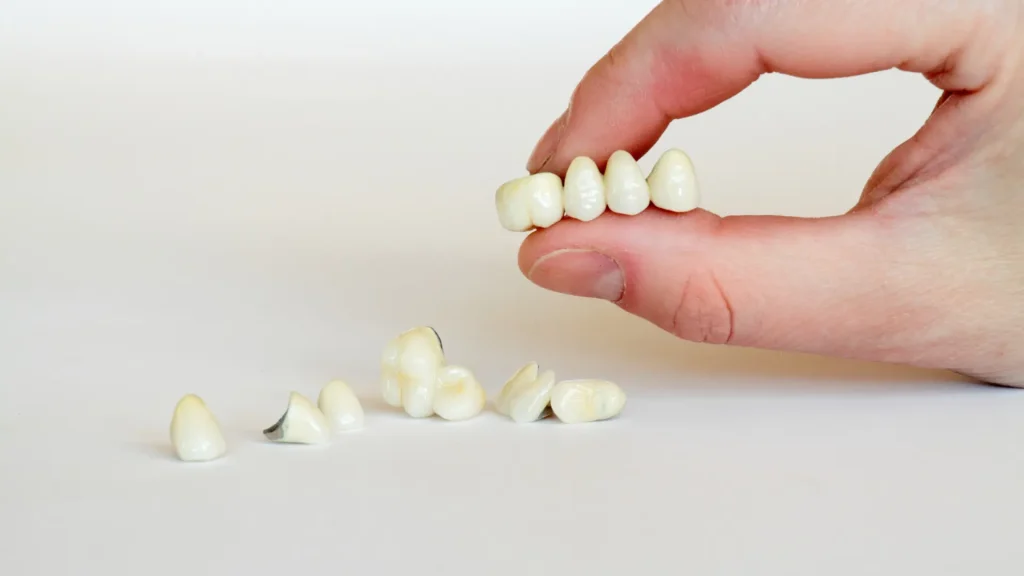
Three restorations doing three different jobs. A crown rebuilds a damaged tooth, a bridge fills a gap where a tooth is missing, and a veneer changes how the front of a tooth looks.
Which one do you need?
| If you have | You probably need |
|---|---|
| A damaged, cracked or heavily filled tooth | A crown |
| A gap where a tooth is missing | A bridge, or an implant |
| A front tooth you do not like the look of | A veneer |
Everything below is the detail.
Dental crowns
A crown is a cap that covers the whole visible part of a tooth. It is used when there is not enough sound tooth left for a filling to work: after a large fracture, when a tooth is heavily worn or misshapen, when an old filling has finally failed, and commonly after root canal treatment, where the tooth has lost a lot of structure and needs its biting surface held together.
The appointments. At the first, the tooth is shaped to make room for the crown, an impression or digital scan is taken, and a temporary crown is fitted so you leave with a working tooth. A laboratory makes the crown. At the second appointment, usually a couple of weeks later, the temporary comes off and the permanent crown is tried in, checked against your bite, and cemented.
How long it lasts depends on rather more than the crown. The material matters, and so does which tooth it is on — a molar takes far heavier loads than an incisor. But the biggest variables are how much natural tooth is left underneath to support it and how well the gum margin is kept clean. Crowns rarely fail because the crown broke; they fail because decay got in at the edge, or the tooth underneath split. Many last well over a decade. Some do not.
When a crown is not the first answer
A crown is not the thing to reach for by default, and there are two situations where it is the wrong first move.
If enough sound tooth remains, a well-placed filling does the same job for considerably less money and takes away less of your tooth. Preparing a tooth for a crown is irreversible, so it is worth being sure a filling will not hold before going further. We will tell you when we think it will.
If the nerve inside the tooth is already infected, the crown is the last step rather than the first. The tooth needs root canal treatment before anything is built over it — crowning an untreated infection seals the problem in and you will be back, usually in pain, with the new crown having to come off.
And if there is genuinely too little tooth left to support a crown, we will say so. A crown on an inadequate foundation tends to fail, and usually sooner than you would want.
One more thing worth knowing before you commit. A tooth that needs a crown has usually been through a good deal already, and in a small number of cases the nerve inside gives up in the months or years after it is crowned — so root canal treatment is needed through or underneath the new work. It is not common, and it does not mean anything went wrong. We would rather you heard it now than the first time it happens.
Dental bridges
A bridge fills a gap by attaching a replacement tooth to the teeth either side of it. It is fixed in place — it does not come out for cleaning — and it involves no surgery, which makes it a good option for people who cannot have or would rather avoid an implant.
The trade-off is straightforward and worth stating plainly: the teeth either side have to be prepared to carry it. They are shaped down, much as they would be for a crown, and they will need crowns for the rest of their lives from then on. If those teeth are already heavily filled or need crowning anyway, a bridge makes a great deal of sense. If they are pristine and untouched, that is a real price to pay, and an implant that leaves them alone starts to look better.
The other thing to know about bridges is cleaning. You cannot floss between the units in the normal way, because they are joined. Cleaning underneath the false tooth with a threader or an interdental brush is not optional — it is what determines whether the bridge lasts.
Veneers
A veneer is a thin shell bonded to the front surface of a tooth. It corrects discolouration that whitening will not shift, small gaps, chips and cracks, minor misalignment, and teeth worn down at the edges.
Two things to be clear about before you decide.
Veneers are irreversible. Fitting one usually means removing a thin layer of enamel, and enamel does not come back. From then on, that tooth needs a veneer or a crown permanently. This is not an argument against them; it is an argument for being sure.
Veneers are not the answer to every cosmetic complaint. If the problem is colour alone, whitening is far cheaper and takes nothing off your teeth. If the problem is that the teeth are crooked, orthodontics moves your own teeth into line rather than disguising their position, and the result generally looks better. Veneers earn their place when the shape or the surface of the tooth is the issue, or when colour cannot be fixed any other way. We would rather send you to the cheaper treatment when it is the right one.
Materials
We work with a range of materials, because they are genuinely good at different things.
Emax all-ceramic is a glass ceramic with excellent optical properties — it transmits light in a way close to natural enamel, which makes it the usual choice for front teeth and for veneers. Strong enough for most situations, though not the strongest option available.
Zirconia is considerably tougher and takes heavy chewing loads well, which makes it a common choice for back teeth. Modern zirconia looks far better than early versions, though for the most demanding front-tooth work Emax still has the edge on translucency.
Porcelain fused to metal has a metal substructure with porcelain baked over it. It is a proven, long-serving combination. The limitation is the metal underneath: it blocks light, and if the gum recedes over the years a dark line can show at the margin.
Full metal crowns are the strongest and need the least tooth removed, but they look like metal. For a back molar in someone who grinds heavily, that trade is often worth making.
Which one suits you depends on the tooth, your bite, whether you grind, and how much it shows when you smile. We will talk it through rather than defaulting to one.
Caring for your restoration
The restoration itself will not decay. The tooth underneath still can, and the join between the two is exactly where decay starts. So:
- Brush the gum margin properly — that edge is the vulnerable part.
- Clean between your teeth daily, and use a threader or an interdental brush under a bridge.
- Go carefully with very hard foods, particularly with veneers and porcelain.
- If you grind your teeth, a night guard protects the work. Grinding is the commonest reason expensive restorations fail early.
- Keep up your check-ups, so a margin that is starting to leak is caught while it is still a small repair.
What it costs
Prices depend on which restoration, which material, and how many teeth are involved, so we quote after looking rather than before. Ask us and you will get an itemised written quote covering the preparation, the laboratory work and the fitting.
One thing worth clearing up, because the figures on our cost guide can be misread: the calculator prices implant-supported bridges, which are a different product entirely — a full arch of teeth carried on implants. That is not the price of a conventional bridge filling a single gap.
Why have it done here
You are seen by the same dentist from the assessment to the fitting, which matters more than it sounds when the shade is not quite right and needs adjusting. We will tell you when a cheaper treatment would do the same job, and when a restoration is not the right answer at all. And because implants, root canal treatment and dentures all happen here too, the choice between them is one conversation rather than three referrals.
Questions
What people ask
before booking
How long do crowns and veneers last?
It depends on the material, which tooth it is on, how much natural tooth is left underneath, and how well the gum around it is kept clean. Many last well over a decade; some fail sooner, usually because of new decay at the margin or a fracture of the tooth underneath rather than the restoration itself giving way. Grinding your teeth shortens the odds considerably.
Will a crown or veneer look natural?
That is mostly a question of material and of which tooth it is. All-ceramic materials let light through in a way closer to enamel, which is why they are used at the front. A metal-based crown is stronger but opaque, which matters much less on a back tooth nobody sees. We will match the shade to your neighbouring teeth and show you before it is cemented.
Bridge or implant — which is better for me?
The deciding factor is usually the teeth either side of the gap. A bridge is supported by them, so they have to be prepared and permanently altered — a real cost if they are healthy and untouched, and much less of one if they already need crowning. An implant leaves them alone but involves surgery, costs more and takes months. Neither is better in the abstract.
Do veneers damage the tooth underneath?
Fitting a veneer normally means removing a thin layer of enamel from the front of the tooth, and enamel does not grow back. That makes it an irreversible decision — the tooth will always need a veneer or something like one from then on. It is not a reason to avoid veneers, but it is a reason not to have them fitted on impulse.
How many visits will I need?
Usually two. At the first, the tooth is prepared and an impression or scan is taken, and you leave with a temporary. At the second, a couple of weeks later, the finished restoration is fitted. A bridge follows the same pattern. Occasionally a third visit is needed to adjust the fit or the shade.
Can I whiten a crown or veneer?
No. Whitening only works on natural enamel. A crown or veneer stays exactly the shade it was made in. If you are considering whitening and you have restorations on your front teeth, whiten first and match the new work to the result — doing it the other way round means remaking the restoration.
Related treatment
Reviewed by Dr Wong Chi Him Benedict, 14 October 2026.
This page is general information about a treatment we offer. It is not advice about your own case, and it is not consent — we go through the treatment, the alternatives and the risks with you at the clinic before anything begins.
No commitment
Ask what your
treatment would
involve
A consultation will tell you what your options are, what treatment would involve and what it would cost, in writing. You are free to leave it there.