
Journal
Missing teeth?
A guide to dental
implants in Singapore
A missing tooth is rarely only a cosmetic matter. It changes how you chew, sometimes how you speak, and often how willing you are to smile in a photograph.
An implant is the closest replacement there is. Here is what one is, what having one involves, and how it compares with the bridge you may have been offered instead.
What a dental implant is
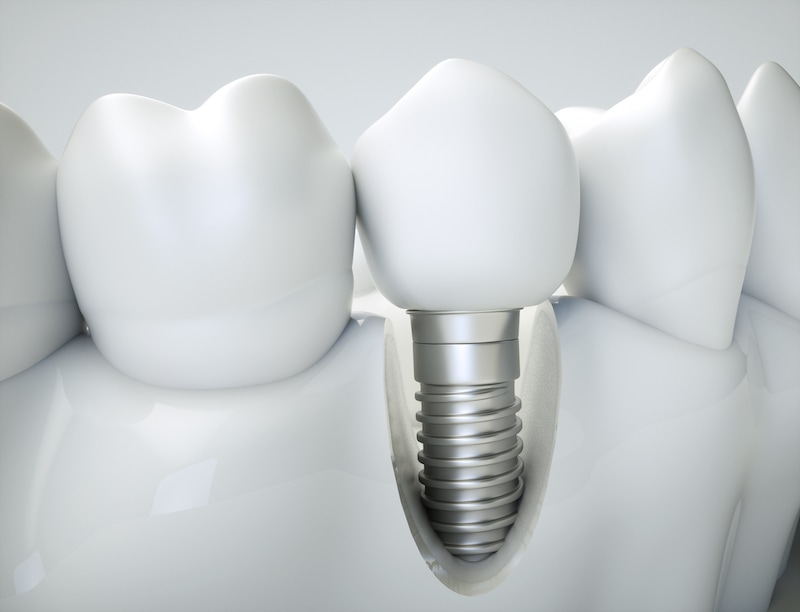
Think of an implant as an artificial tooth root. It is a small screw, made of biocompatible titanium, placed surgically into the jawbone. Over the following months the bone grows against it and holds it — a process called osseointegration — which is what gives it the stability a natural root has.
What goes on top depends on what is missing: a single crown, a bridge carried on two implants, or a denture held steady by several.
What the treatment involves
Implant treatment is an outpatient procedure carried out in stages, with healing time between them. The whole thing usually takes several months.
- Consultation and planning. An examination, X-rays and a 3D scan, to see how much bone there is and whether an implant is realistic. This is also where the alternatives get discussed.
- Placement. Under local anaesthetic, the implant is placed into the jawbone and the gum closed over it, usually with a few stitches.
- Healing. The bone integrates with the implant over three to six months. You brush, eat and travel as normal throughout; the waiting is the only demanding part.
- The abutment. Once it has healed, a small connector is attached to the implant. This is what the crown will sit on.
- The crown. A scan or impression is taken, the crown is made to match the teeth beside it, and it is fitted.
Why people choose them
- Stability. An implant is anchored in bone rather than resting on the gum or hanging from neighbouring teeth.
- Function. Chewing is restored properly, which is what most patients say they notice first.
- It keeps the bone working. Bone that is no longer loaded by a tooth root recedes over time. An implant loads it, which slows that.
- Appearance. A crown on an implant is made to match the teeth on either side of it.
- Longevity. Looked after, implants last a very long time, which changes the arithmetic against a treatment that needs redoing.
Implants and bridges
Both fill a gap; they go about it differently.
A bridge spans the gap using the healthy teeth on either side as supports. Those teeth have to be prepared — reduced in size — to carry it. It is quicker, it costs less, and it is a perfectly good answer where implants are not suitable. What it costs you is two healthy teeth that are no longer untouched.
An implant stands on its own and leaves the teeth beside it alone. It takes longer and costs more, and it needs enough bone to hold it.
Which is right depends on the state of the neighbouring teeth, the bone available, your general health and what you would rather live with. It is a conversation, not a formula.
Am I a candidate?
Most healthy adults are. What matters is gums without untreated disease, enough jawbone to hold the implant — grafting can often make up a shortfall — and general health good enough to heal well. Uncontrolled diabetes and heavy smoking both work against healing, and are worth raising early rather than late.
A consultation and a 3D scan will settle it.
Thinking about it
If you want a permanent, natural-looking replacement for a missing tooth, an implant may well be the right answer — and if it is not, we will say so and tell you what would be. Costs, and where MediSave helps, are set out in the cost guide.
Keep reading